Between the 18th and 19th centuries, portraiture was very popular with much competition. Artists travelled from town to town in search for clients. However not all these painted portraits. Silhouette portraiture was both a poor and rich man's skill. The art was not in the hands but in the personality. Shadow portraits were far cheaper than paintings or sculptures.
The word silhouette was adopted as the new name for these shadow portraits. The word silhouette came from the french Finance Minister "Etienne de Silhouette" during the mid 18th century. He was a despised politician due to his unpopular tax plans who cut shadow portraits in his spare time. "A la silhouette" means reducing something down to its simplest form. It was applied to things that were cheap, such as these shadow portraits.
However, the use of both silhouette and painted portraits declined in the mid 19th century due to the invention of photography in 1829. Photography improved steadily and photographed portraits finally became possible around 1839 and 1840. From then on, people just got their picture taken and the status of artists went into decline.
Nowadays, there are around 100 true silhouette artists in the world practicing this ancient art form. Some of whom I have taken inspiration from for my project such as Lauren Muney, Karl Johnson and Auguste Edouart.
Sunday, 8 December 2013

I became interested in the idea of the silhouette when I learned about its history and its place in time. Nobody really knows who came up with the idea, however there is an ancient story of its origin.
It was written by Pliny the Elder between the years 77 and 79 AD. Long ago, there was a potter named Butades who had a daughter called Dibutade who was deeply in love. Her lover had to leave on a long journey and Dibutade was worried she would forget what he looked like. Since cameras were not invented back then, she sat him down, shone a light at the side of his face and traced the outline of his shadow on the wall. Her father Butades saw the likeness of the man's face on the wall and he pressed clay inside the outline. Soon after, he fired it into his kiln. If this story is true, it may have been the first use of the silhouette as an art form.
The ancient idea of the silhouette has its place in every part of the world. It was used in ancient Egypt in the pyramids, it was used in Greece on vases and China and the Middle East have been known to trace the outline of their shadows made by the sun.
Silhouettes have been around for centuries, however they became especially popular between the 16th century and the mid 19th century. They can also be called profiles, shades, shadows or shadow portraits.
Before photography, silhouettes were very popular and were widely used. Cutting them was a hobby of Catherine de Medici during the 16th century. Silhouettes were used as love tokens by countless soldiers during wartime to remember their loved ones. Profiles were also posted in many families homes for hundreds of years to remember their dead relatives. Before the invention of tracing machines, cutting someones profile was a well respected art form. It was done using only scissors. There was no drawing, tracing or machines used. Silhouette artists who work this way are called " true silhouette artists".
Profile portraits were especially common between the 18th and 19th centuries. They were a cheap way for a working class person at the time to get their portrait done as not everybody could afford a painted portrait. In fact, only a hand full of people had the money to spend on a painted portrait. Between the late 18th and early 19th century, the name of this art form was changed from shadow portraits to silhouettes.
The person who gave me the idea of taking photographs of me skateboarding mid way through a trick at the start of my blog was professional skateboarder, amateur photographer, graphic designer and team manager of toy machine skateboards Ed Templeton. He is renowned for starting up and managing the skateboard company Toy Machine. However, he always had an interest in art and taught himself photography by accumulating various books on the subject. He currently lives in Huntington Beach, California, USA. Here are a few of Ed's skating photographs.


The idea of capturing an image mid way through a trick really appealed to me.
Friday, 6 December 2013
In my earlier posts, I have some silhouette photographs with the background left in. The person who gave me that idea was an amateur photographer called Hengki Lee from Jakarta, Indonesia. He's a business man and does trading for a living, but he does photography and writes poetry in his spare time. He puts an emphasis on the beauty of being different. His photography is remarkable in my opinion. Here is some of his work.


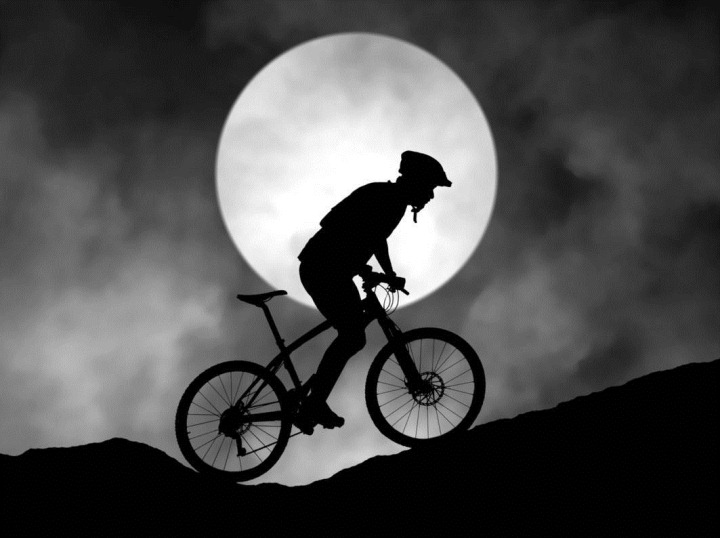
He bases much of his work on poems that he writes himself. He's an individual and stands alone in his photography.
Since I was doing this with the benches anyway, I thought it might be cool to do the same to the trucks of my board as they are dented and marked aswell. The trucks, by the way are the metal part that holds the wheels together. Any grinding on rails is done on these.


I casted this the same time as the bench marks.


This was the final result.

Since the cast of the marks left over on the ledges did not turn out great, I went back a second time to try it again.


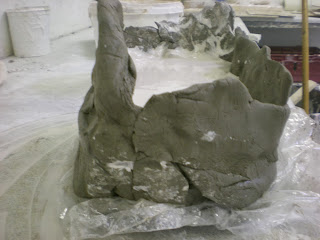


I smoothed the bottom of the clay before pressing it onto the bench to get a more effective print.


Once I had the printed marks, I brought it back to college and made a cast.


I left the plaster set for about 25 minutes and this was the final result.

Better than the last one I think!
Tuesday, 26 November 2013
Paul Chan is another person I took inspiration from to do my shadow figures life sized. He takes a different approach to Kara Walker as he uses shadows and lighting to create his figures on the wall. Here are some of his works.

His shadows depict political problems such as the war in Iraq with America.


His shadows depict political problems such as the war in Iraq with America.


Subscribe to:
Posts (Atom)