Thursday, 17 November 2016
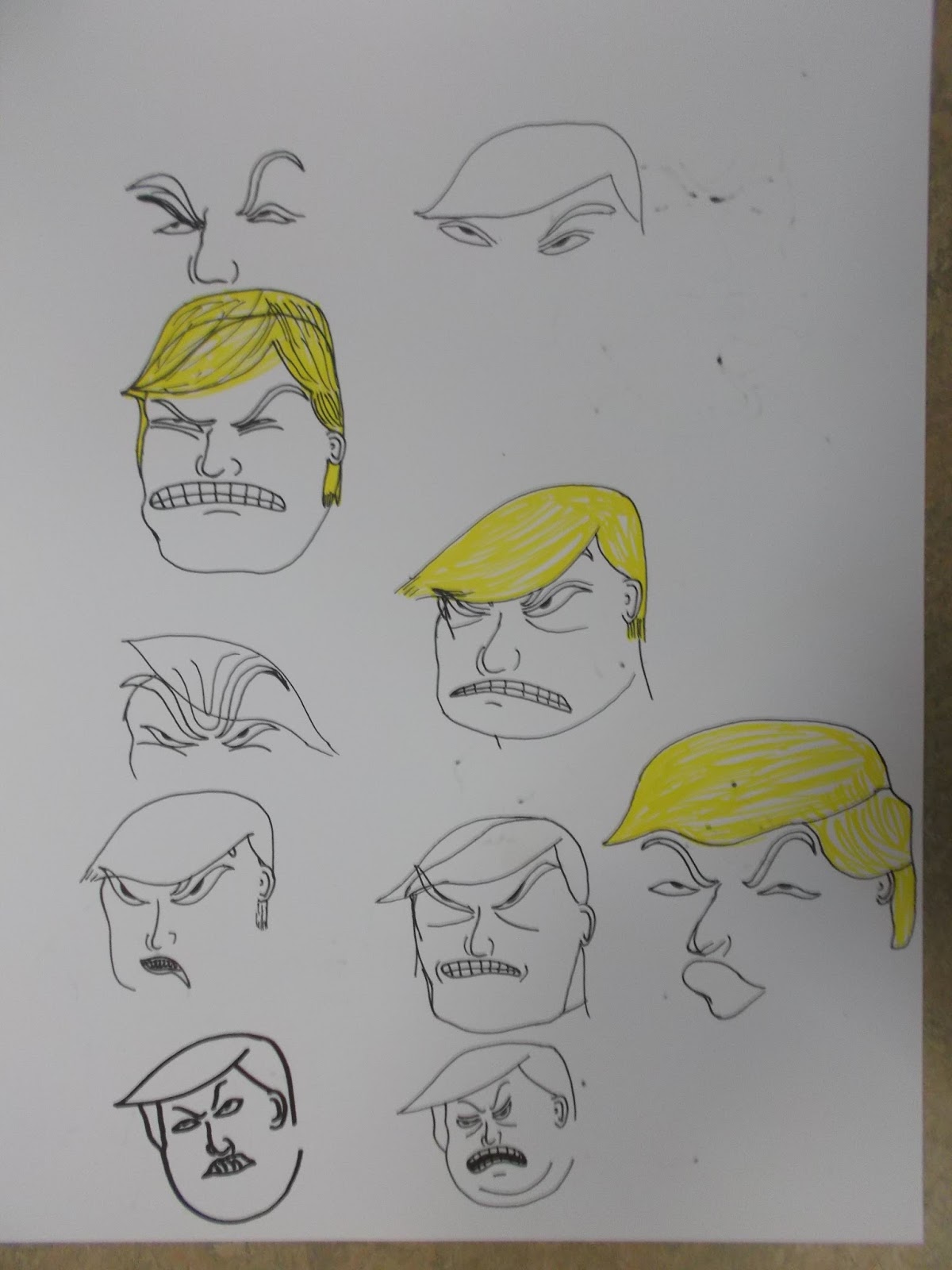
Before I could start ridiculing Donald Trump through my art practice, I had to be able to capture his main characteristics well. These were his hair and his thin eyes along with his angry expression. To me, he always looked like he was smelling something bad, so I tried to capture this. The only thing is, portraiture is not one of my strong points! So I had to work on this first. While I was practicing this I was playing around with caricatures to add the humour aspect to the project. These were my first attempts.
I drew multiple images from google first in my sketchbook and I moved into caricatures after. I had a lot of fun doing these!!
Tuesday, 8 November 2016
"Art and Laughter" by Sheri Klein is a very informative book for the subject I'm dealing with. Between pages 16 and 18 it splits humour different categories and clearly defines all of them. Now it's not just humour I'm working with. Its parody, satire, puns, irony, paradox and dark humour. Below I list the definitions in the book along with my own simplified definitions.
Parody
"Parodies gently mock art, cultural and historical icons through appropriating and altering images, and layering them with new meanings” (Page 13).
“Visual satire mocks art and life with zest and fury and asks us to pay attention to social norms, standards, morals and human foibles. The visual satirist mimics the knowledge and behaviour of a culture or group to overemphasize and exaggerate aspects of life and its foibles with the hope of provoking laughter or a change in attitudes or ways” (page 16).
“A pun can be described as an image with two or more concurrent meanings resulting in the understanding of images on more than one level” (page 17).
Parody
"Parodies gently mock art, cultural and historical icons through appropriating and altering images, and layering them with new meanings” (Page 13).
In
other words, parodies are slightly altered icons which trigger a humorous
response because they portray a different meaning to the original. Often at times we can’t laugh at the original
because it’s too serious or too well respected.
An example of a parody would be the Mona Lisa with a mustache. This evokes a humorous response because it’s
such a famous and respected painting.
Drawing a mustache takes all the seriousness out of it.
Satire“Visual satire mocks art and life with zest and fury and asks us to pay attention to social norms, standards, morals and human foibles. The visual satirist mimics the knowledge and behaviour of a culture or group to overemphasize and exaggerate aspects of life and its foibles with the hope of provoking laughter or a change in attitudes or ways” (page 16).
In
other words, satire uses the enforcement function of humour here in an attempt
to provoke laughter while also making people aware of the errors of our world
and hopefully attempt to correct them through non-violence.
Pun“A pun can be described as an image with two or more concurrent meanings resulting in the understanding of images on more than one level” (page 17).
In
other words, an image or caption with more than one meaning. Eg. I
can’t think of a joke about beavers.
Dam.
The
word dam is related to beavers because they create them in their environment
while damn is also the word we say when we can’t think of something. So the word dam is the source of amusement
here as it carries more than one meaning here.
Irony
“Irony is enabled by using words
or a combination of words and images to express something completely different
from the literal meaning of the word or subject” (Page 18-19).
In
other words, an ironic response is responding with the opposite answer expected
to any given question or statement. For
example, if someone drops a glass and it smashes into shards on the ground and
someone says “well done”, that’s an ironic response. It’s typically use to mock someone or
something.
Paradox
“Paradox is incongruity
achieved through the juxtaposition of images, words and images, techniques,
media and/or ideas, and at first they can seem false, but then we see the
contradictions made apparent and the revealing of something true” (Page 18).
In
other words, it’s a sentence that contradicts itself and at first doesn’t make
sense, however it makes the reader think, leading them to discover some hidden
truth to it.
For
example, Oscar Wilde is famously quoted as saying “I can resist anything but
temptation”.
Other
examples include “The enemy of my enemy is my friend” or “I am nobody” and so
on.
Dark Humour
“Dark humour relies on
the effect of morbidity, absurdity and anarchy.
Dark humour confronts topics such as death, chaos, violence, disasters
and personal crises. It provokes
laughter in the face of tragedy” (Page 19).
In
other words, dark humour allows us to make light of terrible situations we
would normally be traumatised by or deeply affected by such as those listed
above. This kind of humour is often the
source of offence for many people as they feel like there are some things we
shouldn’t joke about. Some artists on
the other hand delight in using this kind of humour to trigger a response from
the audience. Artists listed in this
book include Patty Carroll, Red Grooms, Shag (Josh Agle), Isabel Samaras and
Saul Steinberg.
On
page 19, the book talks about the various techniques which can be used to
trigger a laughter response.
Techniques to Trigger Laughter (Page
19)
- Association – Two images put together giving contrasting effects.
- Transposition – Relocating something in an unusual or new environment.
- Transformation – Altering of a form.
- Exaggeration – Change or distortion of a subject.
- Disguise – Subtle change or meaning.
- Appropriation – Altering a borrowed image.
- Contradiction – Paradoxical or ironic compositions.
The essay "Humour used as a double edged sword" not only explains these theories and how they work, but it also talks about why we use humour and its four functions.
1) Identification
2) Clarification
3) Enforcement
4) Differentiation
The first 2 are used to unite people while the 2nd two are used divide certain groups from others.
Identification
This is an ice breaker. This is when you're getting to know someone and want them to like you so you tell a joke to make them laugh. Now the conversation is initiated and ye're now friends!
Clarification
This is putting forth an opinion. You win over the approval of the people you're talking to by making a joke that makes them laugh and simultaneously agree with you.
Enforcement
This corrects unacceptable behavior. This would be when your friend does something stupid which ends badly for them and those involved. His or her friends will make fun of them and joke at their stupidity. As a result of this kind of humour, the individual will refrain from doing the act againg in case they get mocked.
Differentiation
This humour contrasts oneself from others when standing on a particular issue. For example, if a non religious person jokes that God is an invisible floating man in the sky, they immediately separate themselves from religious people while also making alliances with non religious people in a comical manner.
I've looked at many websites (which are listed in a previous post) and read a couple of books on the subject of humour and how it works. They all talk about these theories and functions in different ways. The two sources that were of most use to me were "Humour as a double edged sword " by John C. Meyer and "The joke and its relation to the Unconscious" by Sigmund Freud. Freud talks about the Analytical, the Synthetical and the Theoretical aspects of humour, however its along similar lines of what I've already explained.
1) Identification
2) Clarification
3) Enforcement
4) Differentiation
The first 2 are used to unite people while the 2nd two are used divide certain groups from others.
Identification
This is an ice breaker. This is when you're getting to know someone and want them to like you so you tell a joke to make them laugh. Now the conversation is initiated and ye're now friends!
Clarification
This is putting forth an opinion. You win over the approval of the people you're talking to by making a joke that makes them laugh and simultaneously agree with you.
Enforcement
This corrects unacceptable behavior. This would be when your friend does something stupid which ends badly for them and those involved. His or her friends will make fun of them and joke at their stupidity. As a result of this kind of humour, the individual will refrain from doing the act againg in case they get mocked.
Differentiation
This humour contrasts oneself from others when standing on a particular issue. For example, if a non religious person jokes that God is an invisible floating man in the sky, they immediately separate themselves from religious people while also making alliances with non religious people in a comical manner.
I've looked at many websites (which are listed in a previous post) and read a couple of books on the subject of humour and how it works. They all talk about these theories and functions in different ways. The two sources that were of most use to me were "Humour as a double edged sword " by John C. Meyer and "The joke and its relation to the Unconscious" by Sigmund Freud. Freud talks about the Analytical, the Synthetical and the Theoretical aspects of humour, however its along similar lines of what I've already explained.
Now that I had my subject to ridicule (Donald Trump), I had to learn how to apply satire to the facts. However at the start of the year I had no idea how humour worked. All I knew was that surprise was a factor like saying unexpected things and I could judge the level of humour of an idea by how much I laughed at it myself. After reading various essays and articles which are linked 3 posts previous to this one under the Donald Trump websites, I learned a little bit about how humour works.
There are currently 3 humour theories.
1) Superiority Theory
2) Relief Theory
3) Incongruity Theory (Dominant Theory)
Superiority Theory
This theory says that we laugh at unfortunate things which happen to others that are not currently happening to us, like someone slipping on a banana peel and falling. Or all those epic fail compilations on YouTube we've all come to love and adore! There is a problem with this theory though. It doesn't always apply. When we see homeless people or orphaned children, we don't laugh at them. So while this theory has some merit, it doesn't explain everything we find funny.
Relief Theory
Relief theory says an amusing reaction is the result of built up feelings within us which no longer apply to a situation. An example would be if a friend is telling us about money they sent to a relative abroad who recently passed away. We build up empathetic feelings for the person. If they go on to say they wasted money on them because they can't use it anymore, we see they don't care about the relative and they're heartless. However we built up feelings of empathy which don't apply anymore so they're released through laughter or amusement.
Incongruity Theory
This is the most accepted theory today. This theory says that laughter is triggered from interrupting our natural thinking pattern and presenting us with an outcome we never expected. An example would be a Frankie Boyle joke. "I got a book on cooking road kill the other day. I tried one of the recipes and it was delicious! But I still don't know what to do with his bike...." The incongruity of this joke is when he mentions road kill, our natural thinking pattern thinks of birds, badgers or fox's etc. However this thinking process is interrupted by the fact that he mentioned "bike" meaning the thing he killed was a human! Now he goes from cleaning the road of a carcass and making use of it to being a murderer, a cannibal and a sociopath! These are not outcomes we would expect from the joke but this surprise of incongruity is why we laugh.
There are currently 3 humour theories.
1) Superiority Theory
2) Relief Theory
3) Incongruity Theory (Dominant Theory)
Superiority Theory
This theory says that we laugh at unfortunate things which happen to others that are not currently happening to us, like someone slipping on a banana peel and falling. Or all those epic fail compilations on YouTube we've all come to love and adore! There is a problem with this theory though. It doesn't always apply. When we see homeless people or orphaned children, we don't laugh at them. So while this theory has some merit, it doesn't explain everything we find funny.
Relief Theory
Relief theory says an amusing reaction is the result of built up feelings within us which no longer apply to a situation. An example would be if a friend is telling us about money they sent to a relative abroad who recently passed away. We build up empathetic feelings for the person. If they go on to say they wasted money on them because they can't use it anymore, we see they don't care about the relative and they're heartless. However we built up feelings of empathy which don't apply anymore so they're released through laughter or amusement.
Incongruity Theory
This is the most accepted theory today. This theory says that laughter is triggered from interrupting our natural thinking pattern and presenting us with an outcome we never expected. An example would be a Frankie Boyle joke. "I got a book on cooking road kill the other day. I tried one of the recipes and it was delicious! But I still don't know what to do with his bike...." The incongruity of this joke is when he mentions road kill, our natural thinking pattern thinks of birds, badgers or fox's etc. However this thinking process is interrupted by the fact that he mentioned "bike" meaning the thing he killed was a human! Now he goes from cleaning the road of a carcass and making use of it to being a murderer, a cannibal and a sociopath! These are not outcomes we would expect from the joke but this surprise of incongruity is why we laugh.
So what makes Donald Trump so different from the rest of the other politicians? While politicians are often greedy, corrupt and in power for their own benefit, I think Trump has set a new low standard.
After reading various articles about him which are linked in the previous post, I learned some scary things about him. Here's what's on his to do list.
1) Build a wall between the US and Mexico to keep immigrants out.
2) Make Mexico pay for that wall.
3) Round up and deport the 12 million immigrants currently working in the U.S.
4) May use nuclear warfare (the U.S. has currently the highest nuclear arsenal in the world with 6970 warheads)
5) Encourage gun use under the 2nd amendment.
There's a lot more but these are a few things he want s to put forth. These goals are chaotic and very unrealistic. Building the wall is laughable. Getting the Mexican people to pay for it is even more hilarious.
Rounding up 12 million US immigrants and sending them home is immoral, impractical and impossible! Most of these people are hardworking who do the jobs most Americans don't want to do anyway like driving taxis, being nannies, caretaking etc. If they go, a large workforce will be terminated. They probably won't want to go either so they'll be most likely be forced to leave at gun point! It's a waste of money and deeply immoral.
Sam Harris makes these points very well as well as pointing out that Trump has very destructive views on reality. Like the notion of human caused global warming is a "Chinese hoax meant to destroy our manufacturing base" (12:12 in youtube podcast, link below).
https://www.youtube.com/watch?v=C3RnrIZxGyE
Given that Trump has a frighteningly little grasp on reality, approves the use of guns and nuclear weapons, wants to spend money destroying Americas workforce and will spend whatever time he has in office spreading his hateful, racist ideology, there's no doubt that this guy is a dangerous candidate to be in the white house. The American president is one of the most powerful people in the world today. If Trump is granted this power, I would imagine all hell breaking loose.
After reading various articles about him which are linked in the previous post, I learned some scary things about him. Here's what's on his to do list.
1) Build a wall between the US and Mexico to keep immigrants out.
2) Make Mexico pay for that wall.
3) Round up and deport the 12 million immigrants currently working in the U.S.
4) May use nuclear warfare (the U.S. has currently the highest nuclear arsenal in the world with 6970 warheads)
5) Encourage gun use under the 2nd amendment.
There's a lot more but these are a few things he want s to put forth. These goals are chaotic and very unrealistic. Building the wall is laughable. Getting the Mexican people to pay for it is even more hilarious.
Rounding up 12 million US immigrants and sending them home is immoral, impractical and impossible! Most of these people are hardworking who do the jobs most Americans don't want to do anyway like driving taxis, being nannies, caretaking etc. If they go, a large workforce will be terminated. They probably won't want to go either so they'll be most likely be forced to leave at gun point! It's a waste of money and deeply immoral.
Sam Harris makes these points very well as well as pointing out that Trump has very destructive views on reality. Like the notion of human caused global warming is a "Chinese hoax meant to destroy our manufacturing base" (12:12 in youtube podcast, link below).
https://www.youtube.com/watch?v=C3RnrIZxGyE
Given that Trump has a frighteningly little grasp on reality, approves the use of guns and nuclear weapons, wants to spend money destroying Americas workforce and will spend whatever time he has in office spreading his hateful, racist ideology, there's no doubt that this guy is a dangerous candidate to be in the white house. The American president is one of the most powerful people in the world today. If Trump is granted this power, I would imagine all hell breaking loose.
Monday, 17 October 2016
I haven't written about them yet but these are links to all the sources I've read since the start of the year.
http://www.mirror.co.uk/news/world-news/6-ways-donald-trump-really-7447955
Article on the faults of trump
https://www.donaldjtrump.com/positions/immigration-reform
Immigration laws of Trump
http://time.com/4437089/donald-trump-nuclear-weapons-nukes/
Trump on Nuclear weapons
http://www.icanw.org/the-facts/nuclear-arsenals/
Nuclear weapons
https://www.donaldjtrump.com/positions/second-amendment-rights
DT on gun control
http://science.howstuffworks.com/5-most-popular-guns.htm
Top 5 guns in America
http://uk.businessinsider.com/americas-gun-problem-2015-6?r=US&IR=T/#more-than-6-in-10-americans-think-having-a-gun-in-their-home-makes-it-a-safer-place-including-81-of-republicans-2
Dangers of gun ownership
http://www.techinsider.io/how-nuclear-weapons-work-2016-1
Nuclear bomb website
http://www.aestheticrealism.net/essays/art-as-humor.html
Art Humour essay
http://www.artnews.com/2004/09/01/whats-so-funny-about-contemporary-art/
Contemporary art humour (Interesting Read)
(1) http://www.artspace.com/adam_mcewen
About the artist
(2) https://whitecubediaries.wordpress.com/2015/04/02/the-jokes-on-you-humor-in-art/
Article on humour in art
https://heavylittlepeoplecomic.wordpress.com/category/social-status/
Dark humour simplicity
https://www.youtube.com/watch?v=FgzFwTG_-wQ
Youtube video explaining how humour works
https://www.youtube.com/watch?v=ya8LkqZolf4
Anti humour Robert Mankoff
https://www.youtube.com/watch?v=jFZuZcvctu0
The science of laughter
http://plato.stanford.edu/entries/humor/
Essay explaining how humour works
http://citeseerx.ist.psu.edu/viewdoc/download?doi=10.1.1.466.1116&rep=rep1&type=pdf Pier reviewed source on humour as a
double edged sword (Read)
https://scholar.google.com/scholar?q=superiority+theory+of+humour&hl=en&as_sdt=0&as_vis=1&oi=scholart&sa=X&sqi=2&ved=0ahUKEwiX0Kjyy_3OAhVoCcAKHUDCAAcQgQMIGTAA
Link to google scholar on how humour is used in various ways
http://grammarist.com/usage/schadenfreude/ Schadenfreude definition-not Wikipedia-ok to
use
Subscribe to:
Posts (Atom)